

(Amman and Paris, 10 September 2018) The military offensive that has been expected for weeks in the Idlib region may lead to one of the worst humanitarian crises ever seen. This new disaster reflects a country ravaged by more than seven years of war, which has already killed 350,000 people and driven more than five million Syrians to flee.
What is being observed on the ground is alarming, at the beginning of an offensive aiming to take over the region of Idlib which is in the hands of the insurgents. Three million civilians living in this region are at risk of being affected by these attacks. The UN warns that this new humanitarian disaster could lead to 800,000 people being displaced.
Dr Philippe de Botton, President of Médecins du Monde France, says: “We are worried about the situation on the ground. The inability of the protagonists in the conflict to agree and the lack of response from the international community cause us to fear the worst. We must act without delay and not leave tens of thousands of children, women and men exposed to the bombing. We demand that international law be upheld in order to find a long-lasting solution for civilian populations.”
Médecins du Monde – Doctors of the World, which is present in Syria, calls for:
We cannot remain silent about the suffering endured by the Syrians. If the international community fails to act, it will bear huge responsibility for what ensues.
Shames and Shirin have been living in Chamesko camp, Northern Iraq, for four years. They are part of the Yezidi community who were forced to flee the atrocities perpetrated by ISIS (Islamic State of Iraq and the Levant/ al-Sham) in 2014.
Shames recounts, “My husband and I were captured by members of ISIS when they stormed our village [in Sinjar, Northern Iraq]. We were lucky enough that their car broke down and saw this as a chance to escape while they were repairing it. Our children were able to escape before ISIS captured the village. Today, most of them live in Germany and I hope that we can join them in the near future. There is nothing left in our village; our house [like many others] is completely destroyed”. When asked if she plans to return home, Shames replies “Of course, I wish I could return to my village someday, but only if it is safe, if my home is rehabilitated and if we receive financial assistance to help us rebuild our lives, but those conditions are far from being met right now”.
In Chamesko camp, Shames lives in a tent near her former neighbors, and when they meet, they cannot help but remember the terror they witnessed first-hand. Perhaps it is only by sharing with each other that they are able to find solace and the strength to carry-on, knowing that only they can truly understand the depth of each other’s sufferings, or perhaps by seeing each other every day they are inevitably reminded of the life they once had and the remnants of those lives now.
‘We cannot return because we simply have nothing left”, Shirin adds. “My family and I fled the day before ISIS came to our village. We had no other choice but to remain in hiding for ten days in the mountains, without food supplies and other necessities. My husband had to carry my son all the way, as he is disabled and cannot walk. It was a very difficult journey and what we witnessed along the way left us emotionally drained. We saw many dead children, whose mothers were forced to leave them behind. We will never forget what has happened to us and so many others like us”. She continues, “Today, we live in this camp, but our living conditions are very harsh. We only have two hours of electricity per day, from 12pm to 2pm, and five hours in the evening. We sleep in the afternoon because of the excessively high temperatures during the day (reaching over 40 degrees Celsius in June, July and August)”. Such high temperatures often cause dehydration, which in turn leads to general fatigue.
International non-government organisations (INGOs) in Yemen strongly condemn horrific Coalition airstrikes on a bus transporting school children in Yemen Thursday 9th August. This bombing follows an unacceptable trend of attacks on civilians and civilian infrastructure by parties to Yemen’s conflict. The killing of dozens of children has escalated the depravity of a war creating untold loss and destruction for people in Yemen.
The humanitarian crisis in Yemen is entirely man-made. Attacks of the kind seen in Sa’ada yesterday are killing and injuring civilians, destroying critical infrastructure and driving more Yemeni people from their homes. Yemen’s slow decline into famine and disease is not a coincidence but the product of ongoing violence with grossly unfair consequences for millions of civilians.
We appeal to all parties to this conflict to make public commitments to cease attacks on civilians. We call for an immediate investigation into yesterday’s attacks by an independent panel of UN experts and meaningful support from members of the UN Security Council to the political process being led by the UN Special Envoy, Martin Griffiths. There is no military solution to the conflict in Yemen. Parties to the conflict, including the governments that continue to arm and support them, must be held to account for actions that violate International Humanitarian Law and continue to fuel a preventable crisis.
Signed,
Action Against Hunger
ADRA
CARE
Danish Refugee Council
Global Communities
Handicap International
INTERSOS
International Rescue Committee
Islamic Relief
Médecins du Monde
Mercy Corps
Norwegian Refugee Council
Oxfam
Relief International
Save the Children
War Child UK
ZOA
We, the undersigned humanitarian and human rights organisations, strongly condemn the major attacks that hit a fish market and the entrance to Yemen’s largest hospital, Al Thawra, in Hodeidah on 2 August, which reportedly killed over 40 civilians, including children. Hospitals are protected under International Humanitarian Law (IHL) and parties to the conflict are obliged to do everything possible to protect civilians and civilian infrastructure, as the UN Humanitarian Coordinator in Yemen, Lise Grande, emphasised in her condemnation of the attack.
We urge world leaders including the UN Security Council to condemn the attack in the strongest possible terms, and call for an urgent investigation to ensure that those responsible for any violations against international humanitarian law, especially attacks against civilian targets and medical infrastructure, are held accountable. We call upon all those with influence with parties to the conflict to demand that they immediately cease these reckless attacks that risk innocent lives, and instead engage meaningfully and constructively with the UN Special Envoy to work towards an immediate ceasefire and political solution.
We particularly remind the UK, US and France that, as key supporters and arms suppliers to the Saudi/Emirati-led coalition, as well as permanent members of the Security Council, that they bear a special moral and legal responsibility to ensure that the coalition fully complies with the rules of IHL. In light of the ongoing violations against civilians by all parties to the conflict, we reiterate our call to all states to cease the supply of all arms at risk of being used in Yemen.
Signed,
Action Contre La Faim (ACF)
ADRA Yemen
CARE International
Danish Refugee Council (DRC)
Global Communities
International Medical Corps (IMC)
INTERSOS
Islamic Relief
Médecins du Monde
Mercy Corps
Norwegian Refugee Council (NRC)
Oxfam
Première Urgence – Aide Medicale Internationale (PUAMI)
Relief International
Saferworld
Save the Children
War Child UK
ZOA
The Médecins du Monde (MdM) chapters in Palestine express great concern and join the international community outrage regarding the demolition of the Bedouin community structures in Abu-a-Nuwar by Israel and the expected demolition of Khan Al-Ahmar, affecting hundreds of Palestinian Bedouins.
On 3 July 2018, the Israel Civil Administration (ICA) started to prepare the demolition of the Bedouin community of Khan al-Ahmar and declared the area a military zone, following the 25 May 2018 Israeli High Court of Justice ruling to demolish it. Khan al-Ahmar is home to 235 people, 53 per cent of whom are children and 95 per cent of whom are Palestinian Bedouin refugees. While the eyes of the international community were on Khan Al-Ahmar on Wednesday 4 July, the Israeli Civil Administration demolished 19 structures, displacing 51 people in Abu-a-Nuwar, another Bedouin community home to approximately 650 Palestinians.
The Bedouin community, mostly living in extremely difficult conditions in the West Bank and Negev, is particularly vulnerable with important humanitarian aid needs. The Bedouin families of Khan Al-Ahmar and Abu-a-Nuwar moved there after being expelled in the 1950s from their pastoral lands in Beersheba. In 2016 only, the Abu-a-Nuwar school was partially destroyed in three different occasions and in February 2018, two school structures of this community were demolished. Despite the last-minute Israeli High Court of Justice injunction suspending temporarily the demolitions, the families of Khan al-Ahmar remain at high risk of being dispossessed from their homes and relocated against their will. Today, 46 communities are also at risk of demolition and forcible transfer.
Since 1967, Israel has been pursuing a planning and zoning regime aimed at expanding its settlements in the West Bank and East Jerusalem. While the ICA has designated 70% of Area C (44% of the West Bank) for Israeli settlements or military use, only 1% of Area C has been assigned for Palestinian constructions. This has resulted in 5,450 demolitions and 8,353 displaced people since 2009. To counter this, in late 2014 the UN Security Council (UNSC) adopted Resolution 2334 condemning the demolition of homes and displacement of civilians as well as reaffirming that the establishment of settlements in the West Bank “constitutes a flagrant violation under international law.” Notwithstanding this state-binding resolution and the reiterated international condemnations, forcible transfers persist while settlements continue to expand.
Present in Palestine for over 23 years, MDM has been working on the psychosocial impact of occupation-related violence and forced displacement, including the communities of Khan Al-Ahmar and Abu-a-Nuwar, as well as attending the post-detention psychosocial needs of children and young adolescents in the West Bank.
The three MDM chapters in Palestine, namely Doctors of the World France, Spain and Switzerland, condemn Israel’s evictions and demolitions of Palestinian houses, and service structures throughout the West Bank. In this regard, the MdM chapters reiterate that under the fourth Geneva Convention, the unlawful destruction of property and the forcible transfer of protected persons under occupation represent grave breaches and liable to penal actions.
The MDM chapters join the international community call upon Israel to reverse these decisions and fully meet its obligations as an occupying power under International Humanitarian Law.
Finally, the MDM chapters urge the international community to resort to appropriate measures to bring Israel into compliance with its international obligations, including concrete measures to ensure the application of UNSC Resolution 2334 and demand restitution or compensation from the Government of Israel for the demolition or confiscation of Palestinian property funded by donors.
Médecins du Monde (MdM) contributed to the 72nd edition of Humanitarian Exchange magazine, issued in July 2018 with a special focus on mental health and psychosocial support in humanitarian crises.
Joining their efforts, Marie Darmayan and Dia Abou Mosleh, mental health Coordinators from both MdM Iraq and Lebanon missions, wrote a joint article entitled: “Supporting mental health care provision in Lebanon and Iraq”. They exposed challenges and opportunities they face in the field, while taking into consideration the context of the respective countries. The article also reflects MdM’s experience in these two crisis-affected countries as a first response to the people’s immediate mental health needs and as a future long-term program, in terms of advocacy, by working closely with all stakeholders in order to build a national framework to ensure sustainability.
In addition, Patricia Moghames, MdM Field Work Coordinator in Lebanon for research studies in collaboration with Queen Mary University of London, also contributed to this special edition. High-quality research on the mental health needs of Syrian refugees should play an important role in planning and providing services, yet conducting mental health research to a high standard in a refugee setting is particularly challenging. The article, entitled “Mental health research among Syrian refugees in Lebanon: challenges and solutions”, describes two research studies with Syrian refugees in the Beqaa region of Lebanon, setting out some of the challenges faced and the lessons learned in the process of conducting the research.
You can read and share:
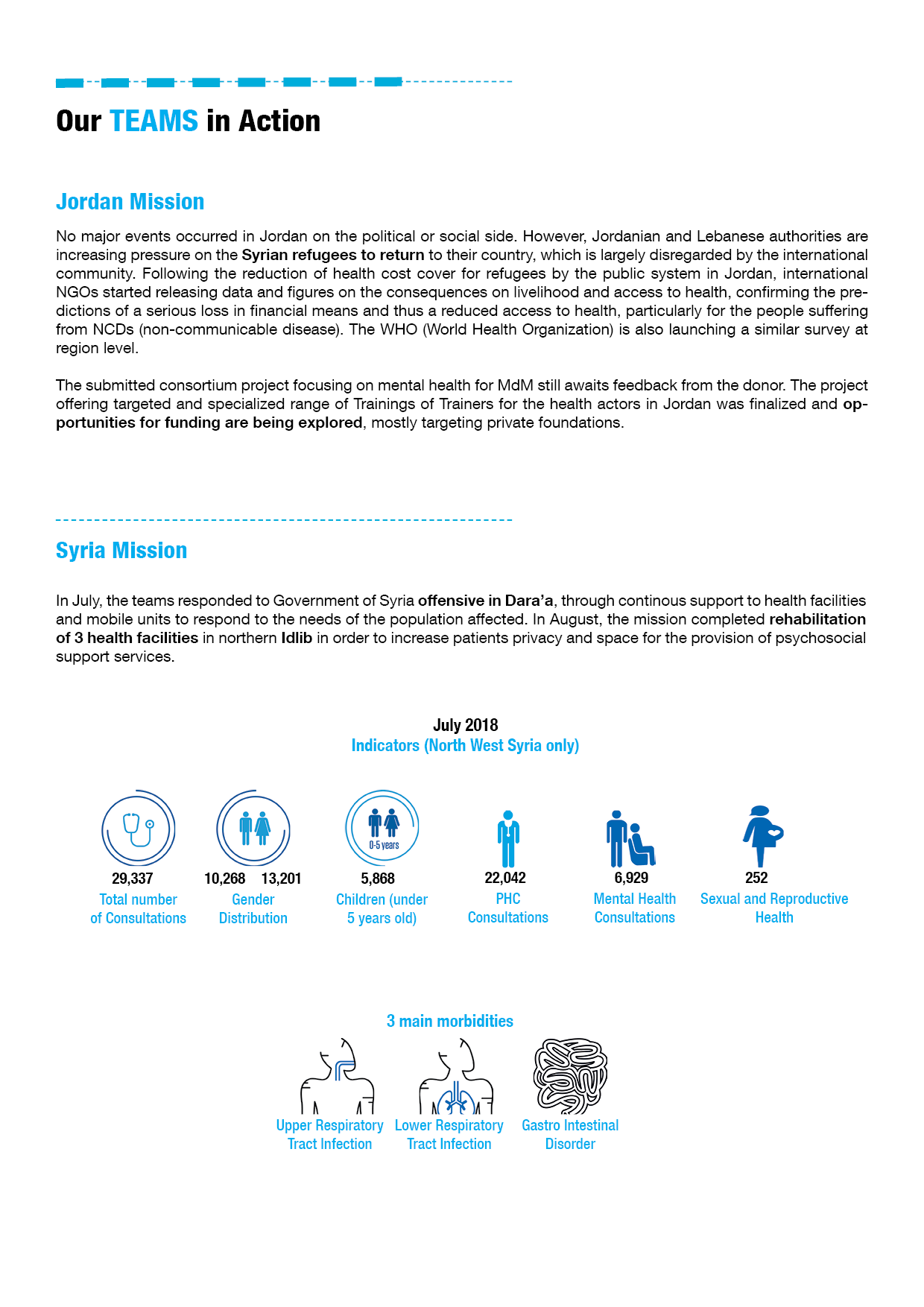
It has been one week since the commencement of the military offensive in Dera’a governorate, which has led to a massive wave of displaced civilians. Health center staff, supported by Médecins du Monde, are continuing their immense efforts to take care of IDPs fleeing airstrikes and military activities. Medical personnel are working tirelessly amidst the crisis, to respond to the needs of the Syrian people. Most of the time the health staff are working at the cost of their own life and security.
As one member of the medical team stated: “In this situation of emergency, we have formed a complete medical team composed of a doctor, a pharmacist, a nurse, a logistician, and a staff member in charge of documenting the situation. The team visited a group of schools hosting about 40 families with approximately 150 people.The outcome of our visits is that the elderly members of the community are provided with necessary medications for chronic conditions which can otherwise prove life threatening (diabetes, blood pressure etc). Essential medications are also provided to care for the wellbeing of newborns and young children. Persons who have been injured during the military offensive are provided life-saving treatment and follow-up. Also, given the heightened risks of communicable and infectious diseases, information is provided to displaced persons and their families with the aim to stem the spread of disease and improve overall health and wellbeing.”
EDIT: The international humanitarian conference will not take place. It has turned into a meeting of experts and representatives of different UN agencies.
15 NGOs appeal to President Macron on eve of humanitarian conference on Yemen in Paris
Paris, 26 June 2018 – 15 humanitarian and human rights organizations today urged Emmanuel Macron and the French government to use all means at their disposal to press their allies, including Saudi Arabia and the United Arab Emirates, to minimize harm to civilians during the attack on Hodeidah city, home to Yemen’s most important port. The international humanitarian conference on Yemen organized in Paris on Wednesday 27 June will be useful only if it contributes to preventing this new humanitarian disaster and improving the protection of civilians across Yemen, say NGOs.
The Saudi and Emirati-led coalition launched an attack on June 13 against Houthi rebels around Hodeidah port, on the west coast of Yemen, through which more than 70% of imports enter the country. Hodeidah is a lifeline for more than 20 million Yemenis who rely on outside aid to survive. UN Special Envoy for Yemen Martin Griffiths warned two months ago that an attack on Hodeidah could “in a single stroke, take peace off the table”. Fighting for port control also poses a disproportionate risk to civilian populations.
Even before the Hodeidah attack, Yemen was facing an unprecedented humanitarian crisis, directly linked to three years of conflict and the warring parties’ restrictions on humanitarian aid and access, including the coalition-imposed sea and air blockade on parts of Yemen under Houthi control. UN humanitarian coordinator for Yemen, Lise Grande, on Friday warned of the threat of a new cholera oubreak due to a possible water system break down in Hodeidah – just months after Yemen grappled with the largest cholera epidemic in modern times with over one million suspected cases.
Thousands of people have already been displaced by recent fighting and the risks to civilians from the Hodeidah offensive are all the more serious given the track record of all parties to the conflict. In three years of war, the coalition forces have repeatedly violated international humanitarian law, using explosive weapons with wide area affect in densely populated areas, bombing schools and hospitals, and blocking aid and access. The Houthi forces they are fighting have also laid antipersonnel landmines, restricted humanitarian access and indiscriminately shelled densely populated areas in Yemen.
France’s willingness to do more to address the crisis in Yemen is welcome. However, several NGOs have recently expressed, in an open letter to President Macron, their concerns about the humanitarian conference on Yemen of 27 June, co-chaired by Saudi Arabia – a party to the conflict –, as a major offensive is under way. The French initiative, now downgraded to a meeting of experts, will be judged on its ability to secure clear commitments from Saudi Arabia and its allies to minimize risks to civilians during the Hodeidah attack and across Yemen, NGOs said today.
The 15 signatory organisations call on France to:
The 15 signatory organisations are: ACAT, Alliance internationale pour la défense des droits et des libertés, Amnesty International, Action Contre la Faim, CARE France, Handicap International, Human Rights Watch, Observatoire des Armements, Norwegian refugee Council, Médecins du Monde, Première Urgence Internationale, Saferworld, Salam for Yemen, Save the Children, SumOfUs.
Dr. Jean-François Corty, International Operations Director, Médecins du Monde
“The blockade of the coalition, which is akin to collective punishment, and the attack on Hodeidah amplify the deterioration of living conditions and access to care for civilians. France must actively pursue a conflict resolution diplomacy to limit the worsening of the humanitarian crisis.”
Fanny Petitbon, Advocacy Manager, CARE France
“The port of Hodeidah is the lung of Yemen. It is the entry point for 70% of food, medicine, gas and humanitarian aid. If the port stops working, people will not be able to support themselves for long: the stocks will not last more than two months and the whole country is at risk of asphyxiation. France must use all the levers at its disposal to immediately stop the offensive on the city and support the UN efforts to take control of the port and accelerate the peace process. This is the only way to avoid a humanitarian catastrophe.”
Jan Egeland, Secretary General of the Norwegian Refugee Council (NRC)
“More and better aid is urgently needed for millions faced with starvation, disease and deprivation. But only cease-fire and peace talks can end this man-made hemorrhage of human lives. The Paris conference must therefore focus on ending this senseless war. France, the US, UK have earned big money on arms sales to those waging war and we demand they use their influence to push Saudi Arabia and the UAE to the table, just as we demand that Iran use their leverage on Ansar Allah before the conflict escalates beyond hope.”
Anne Héry, Advocacy Director, Handicap International
“Bombing civilians in Yemen is a crime, not war. France’s engagement only makes sense if it does not compromise on the protection of civilians and humanitarian access throughout the Yemeni territory.”
Stéphanie Lord, Hodeidah Field Coordinator, Action Against Hunger (ACF)
“In Hodeida, our teams support more than 4000 children suffering from acute malnutrition per month on average and complete more than 7,600 medical consultations per month. However, the current military intervention in Hodeida is leaving hundreds of thousands of women, men and children stranded without any support or access to humanitarian aid. We are extremely worried about not being able to reach people in need as the warring parties advance, leaving civilians caught in the middle.”
Robert Parker, Director of Policy, Saferworld
“Addressing human suffering in Yemen requires more than humanitarian efforts; it requires building peace. There can be no military solution to the war in Yemen. International actors like France, the UK and the US, must stop material and diplomatic support to the warring parties and focus on an inclusive peace process in which the voices of Yemen’s women, men and young people are heard.”
Racha Mouawieh, Yemen Researcher for Amnesty International and author of the report “Stranglehold: Coalition and Huthi obstacles compound Yemen’s humanitarian crisis”
“For the last three years, the restrictions imposed by the Saudi-led coalition have prevented Yemenis from obtaining vital products they desperately need. The deadly military offensive carried out by the coalition against Hodeidah will aggravate an already catastrophic situation and endanger millions of civilians. France must stop looking away while Yemen slowly suffocates.”
Bénédicte Jeannerod, France director, Human Rights Watch
“The battle of Hodeida raises huge concerns about its potentially devastating impact on civilians throughout Yemen, already suffering during more than three years of conflict from large-scale violations by all sides, notably the Saudi-led coalition. France and Saudi Arabia have undertaken with great fanfare a humanitarian conference on Yemen. Its usefulness will be judged by its concrete results for civilians: the end of unlawful attacks on civilians, unrestricted access to humanitarian assistance, and ensuring civilians can flee the fighting for safety. France should act consistently with its claimed support for human rights in Yemen, by ending all weapons sales to the Saudis, who have repeatedly violated the laws of war and taken no action against those responsible”.
Hélène Legeay, Maghreb/Middle East Program Manager, ACAT
“France is officially expressing its concern over the humanitarian crisis affecting Yemeni civilians, but is proving much more silent with regards to the sale of French weapons that could be used against these same civilians. In contravention of the Arms Trade Treaty and the Military Programming Law, it has still not published its annual reports on its exports of war materials. This silence is more than dubious.”
Olivier Routeau, Operations Director, Première Urgence Internationale
“The risk to the civilian population of Hodeidah is now immense. These populations’ access to basic services will be interrupted if the assault continues or in case of attempted encirclement of the city. Drinking water distribution networks are already damaged, in an area where temperatures will soon rise to extreme levels, and cholera will re-emerge seasonally. The urgency to find a diplomatic solution for Hodeidah and its port has never been higher.”
Tony Fortin, Research Officer, Observatoire des Armements
“Although there is suspicion of massive French arms involvement in Yemen – including Leclerc tanks in Hodeida province – the government has still not published its annual report to Parliament on arms sales. In doing so, the State violates its own law since the deadline for the publication of such data is set on June 1st by Law No. 2013-1168 of December 18th, 2013. This reflects a clear delay compared to other European powers (The United Kingdom, Germany, Sweden, the Netherlands) in which Parliaments have access to data on arms contracts and have broad supervisory powers in the matter “
Sadek Alsaar, President, Salam For Yemen
“Beyond the conflict that has killed more than 10,000 people and injured 50,000, the blockade on Yemen is deadlier than the fighting. The attack on the port of Hodeidah, the main point of entry for food and humanitarian aid, is likely to worsen the situation of this country, where 90% of food needs are imported.”
Eoin Dubsky, Campaign Manager at SumOfUs
“The urgency of the situation in Hodeidah should more than ever convince the French government to respect the Arms Trade Treaty. More than 101,000 people signed the SumOfUs petition calling on President Macron to stop French arms exports to countries involved in the Yemeni conflict. A recent survey conducted by YouGov for SumOfUs indicates that 75% of French people are in favor of suspending these exports, while nearly 70% support greater parliamentary oversight on these issues.”
25 June 2018
The whole world is blissfully caught up in the World Cup hosted by Russia, and meanwhile, the Syrian government has been leading ground offensives and aerial bombings on the south of Syria, with the help of their Russian ally. These strikes were met with the World’s most blatant indifference. Médecins du Monde (MdM) is raising deep concern about the escalation of hostilities, which are severely endangering the lives of civilians and causing massive displacements. MdM is blowing the whistle on the ongoing humanitarian crisis and the necessity to safeguard the means of protection of the population and of their access to healthcare facilities and treatments, as should be in compliance with the international law provisions.
The news from the ground are extremely alarming. The governorate of Dara’a, which is supposed to be a de-escalation zone, has been facing shelling and fighting for several days, in outright violation of the ceasefire arrangements that had brought a semblance of tranquillity in the south of Syria last year. One health facility in Bosra el Harir was damaged last night, and the city of Dara’a severely bombed. The escalation of hostilities resulted in the death of civilians, and many others were injured. The fighting also led to the displacement of at least 12,000 people from the northern governorate of Dara’a towards the rural governorate of Quneitra as well as towards the Jordanian border, where there is no form of sheltering available.
The population, an estimated total of 750, 000 people, is trapped in Dara’a and has nowhere to go, as the three directions in which they could flee (East, West, and North) are the areas where the attacks come from. Moreover, the border with Jordan is shut. The Dara’a governorate declared the state of emergency in all of eastern Dara’a. MdM field staff reported witnessing the use of alleged non-conventional weapons in the attacks.
A field MdM medical staff says: “Medical workers are facing major difficulties in the midst of the current escalation of violence. Let’s take the example of a hospital in the north of eastern Dara’a, which is the only care centre providing secondary care, including dialysis. This health facility tried to address the needs of the numerous people injured in the entire area. But the increasingly violent context made our work very difficult in trying to care for the population, and secure the families at the same time. Some of us had no choice but to make the decision to leave the location, and thus the health facility, because of the lack of protection. Recently, a midwife and her infant daughter were killed during a shelling”. In areas of displacement, medical staff are mobilised to provide consultations wherever people are hosted, in schools, for example. MdM is supporting five health facilities in the region, providing medication and technical support.
Dr. Philippe de Botton, President of Médecins du Monde France, stated: « While the world is watching the World Cup organised in Russia, the international community cannot turn a blind eye to the escalation of violence currently taking place in south Syria and its consequences on the thousands of civilians living in the area. We urge decision-makers to take all effective measures to uphold the ceasefire arrangements and safeguard civilian lives and the protection of health facilities and health workers, as required by international humanitarian and human rights law. The situation in Aleppo or Eastern Ghouta must never occur again, although we do fear it is most likely to.”